


Actively Nourish Life.
Respect the Pace of Biological Adaptation
熾火焼き菊池
Where Our Menu Stands
Our shared menu is designed around physiological taste — the body’s native sensory system.
We intentionally reduce sensory noise so the body’s native feedback systems remain intact.
The goal is not intensity or novelty, but clarity — allowing real ingredients to be perceived without interference.
-
why flavors are restrained
-
why salt is measured
-
why charcoal, FIR, and simple preparation matter
-
why some people feel “deep satisfaction” rather than excitement
The Three Layers of Taste
Taste is not a single thing.
It operates across multiple layers, each shaped by different forces.
1. Physiological Taste (Biological Layer)
Physiological taste is the body’s native sensory system.
It reflects how Homo sapiens detect nutrients, minerals, energy density, and safety through taste, texture, and aroma.
This layer evolved over long timescales and is closely tied to digestion, satiety, and metabolic feedback.
Key characteristics:
-
Works best with low sensory noise
-
Sensitive to real nutrients
-
Self-regulating when signals are clear
-
Easily overridden by stimulation
2. Cultural Taste (Learned Layer)
Cultural taste is learned through habit, tradition, and environment.
It reflects regional cuisines, family cooking, rituals, and shared memories.
This layer can coexist with physiological taste, but it can also mask it.
Key characteristics:
-
Neutral by itself
-
Can support or conflict with physiology
-
Highly variable across societies
-
Often reinforced socially, not biologically
3. Addictive Taste (Engineered Layer)
Addictive taste is designed, not evolved.
It is created by amplifying sugar, fat, salt, aroma, and texture to override biological stop signals.
This layer prioritizes repeat consumption over nourishment.
Key characteristics:
-
High stimulation, low resolution
-
Requires escalation over time
-
Weakens sensitivity to real food
-
Decoupled from nutritional value
Summary
-
Physiological taste regulates.
-
Cultural taste remembers.
-
Addictive taste overrides.
Our menu is built on the first.
熾火焼き菊池
Influences of Ingredient Choices
Through the Lens of Homo Sapiens Ecology
-
Produce and livestock grown in natural soil systems by ecologically consistent producers
-
Wild & Pasture-raised animals
-
Fresh, whole foods grown in natural soil systems by ecologically consistent producers, without reliance on synthetic acceleration or marketing-driven claims.
Nourishment
Long-Term Biological Load (Over Decades)
-
Commercially Farm-raised meat & seafood
(when raised on unnatural diets: grains, GMO feed, hormones)
• Processed foods
• Refined vegetable seed oils
• Ultra-processed and synthetic ingredients
• Crops and livestock
dependent on GMOs, pesticides, or herbicides
Risk
-
Uncooked stems, roots, and leaves — Unlike ruminants, Homo sapiens lack the digestive systems to neutralize many of the natural defense chemicals in plants, such as oxalates. These parts are safest when cooked, fermented, or traditionally prepared.
Dec 24 | 2025, in progress
"We run best on what shaped us—real food."
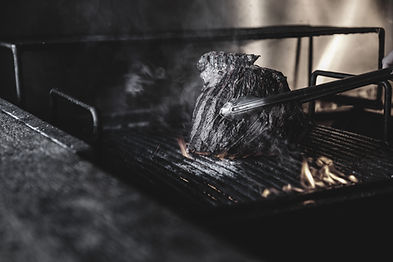
The functional qualities of our food are outcomes of method — not added stimulation. They result from:

Charcoal: Dry, stable heat with minimal interference
Charcoal is composed primarily of carbon and burns with low moisture contribution, producing a dry, stable heat source.
This dry heat promotes surface dehydration, allowing foods to develop a crisp exterior without relying on excessive temperature or added fats.
In addition, charcoal’s porous structure can adsorb certain volatile organic compounds produced during cooking, helping reduce off-odors and preserve flavor clarity.

Far-infrared energy: Even internal heat distribution without surface shock
During the ember stage, charcoal emits far-infrared (FIR) energy, when combustion has stabilized and heat output is most consistent.
FIR transfers energy efficiently into food, warming water, fats, and proteins more evenly than surface-intense heat alone.
This allows internal temperature to rise gradually, improving moisture retention and texture while supporting controlled browning without excessive surface stress.

Aroma as a biological signal: Indicates digestibility and safety after transformation
The aroma produced during cooking functions as a biological signal, indicating that food has been transformed into a safer and more digestible state.
Heat reduces microbial risk and alters structural and defensive compounds, increasing nutrient availability and bioavailability.
This is particularly relevant for fibrous plant foods, especially leaves, stems, and roots, which often contain natural defense chemicals. Cooking reduces these compounds, making the food safer and easier to digest.

Natural Sea Salt: Used as a functional electrolyte, not a masking agent
Natural sea salt provides sodium along with trace minerals present in its original source.
Used in measured amounts, it supports electrolyte balance, nerve signaling, and hydration while enhancing food without masking its natural signals.
We use salt as a functional tool — not as a means of artificial stimulation.

We use ember grilling because it remains reliable within known biological limits, and we remain open to better methods if and when they prove their value.